
The Creative Mind
At one time or another, all successful artists, musicians, poets, and writers are asked about their creative mind, how they process ideas, and why they create.
We hear creative people speak about perspective, idea generation, creative insight, and how, so very often, creativity comes from asking a simple question.
Einstein once said that if he had an hour to solve a problem, he’d spend 55 minutes thinking about the question and 5 minutes solving the problem.
Psychologically, a creative mind does not create insight until a problem has been reframed and ideas have been generated - and not everyone has the capacity to think creatively.
Creativity flows through a scientific process.
In search of excellence, artists don’t just look to understand their ideas; they expand upon them. Most people don’t like to admit it, but creativity is biologically determined, and the art that biology produces is feared.
And if you want proof of this fear, just go into someone’s house. One of the most obvious ways to determine if someone is artistic is to observe their art collection. The chances are, if the owner of the house doesn’t like art, they’re not artistic.
But the real fear is generally evident by the colour of the walls.
The most common colours for painting an interior wall are off-white and grey. You would think that, with the climate providing a constant metallic finish, the English would have enough greyness in their lives already.
A few years ago, Canadian homeowners were asked why the most common colour for interior walls in Canada is beige. The answer provided was that they were afraid to paint more creatively, in case they couldn’t sell the house. They assumed that a potential buyer would frown upon the depth and beauty of colour and ridicule their abode.
I, for one, love colour. I aim to be different. I want my paintings to cause a profound reaction and be distinguishable and identifiable with my unique style. I am Marmite - it’s a love/hate relationship.
3 Stages of the Creative Mind
Technically speaking, there are three reliable approaches the creative mind subconsciously takes. The first one is reframing the problem. By saying that he was spending most of his time thinking about the problem, Einstein was pointing out the capacity to ask a better question.
Artists challenge systems, conventions, and assumptions, and this is why the best creative minds ask good questions to understand how to reframe things - pun intended.
The second step is one most people try to force: idea generation. Companies drag marketing executives into boardrooms and force ideas through a series of brainstorming exercises.
With limited time, it is expected that employees shift their perspective, think laterally, and generate ideas on the spot.
We are told that the ‘alternate uses task’ helps us to reframe ideas about a given project, and this is great, but the third and final step to create insight, the naturally creative brain requires its neural correlates to shift their frequency, and this is only achievable at certain times of the day.
It has been scientifically proven that the best ideas come when the brain shifts from beta brainwaves to alpha ones. Paradoxically, the best ideas arrive when we disconnect our creativity machine. The naturally creative brain requires time to wander in order to shift perspective. Often, after taking a bath, showering, strolling, or waking from a nap, we then gain clarity.
Likewise, we fail to notice the frequency shift in our own brains, but we may notice the habits of other artists more. I just know what moves my own creativity.
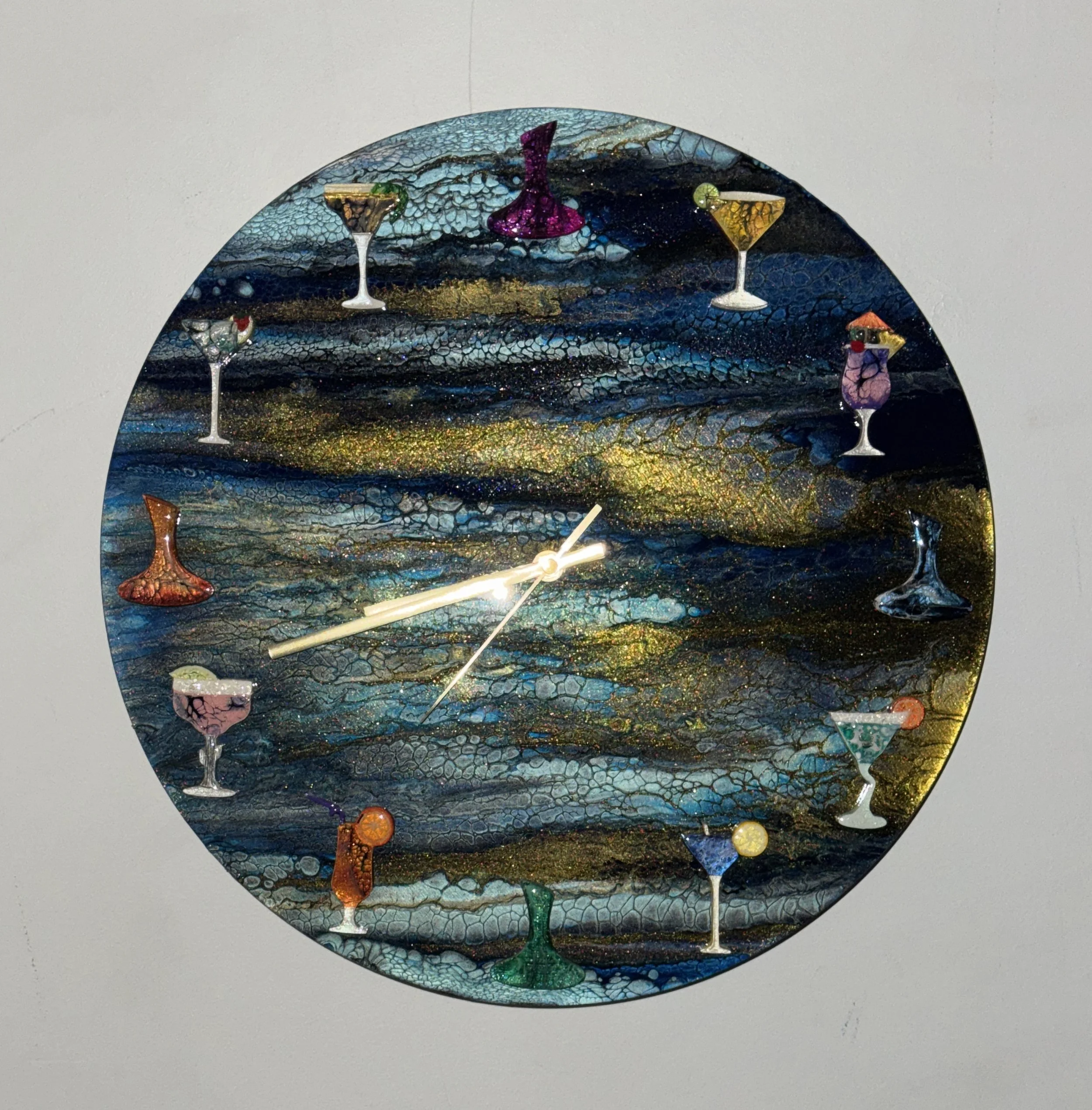
For me, it is very often the case that the painting evolves once underway. Ideas for enhancement/refinement will pop into my head and demand attention, so there may be a variance from the original intention - in a positive way. All my work is finished with resin - expensive and time consuming but worth it for the glossy finish and vibrant colour.
When the outline plan follows an idea, the next consideration is ‘how’. This is where I will be determining size, substrate, materials, colour palette, and whether to add sculptural elements or 3D effects.
My general routine is…I paint. I create obsessively. I am a mole - if I am in the UK, my basement studio is where you will find me. My husband calls me subterranean. It’s my happy place, and artists are generally in a moment of relaxation and happiest when their brain is at its most creative.
Art for a biological sake
People often use examples of torment as a time when certain artists were at their most prolific. However, despite the turmoil, you will generally discover that an artist’s best work was created following times of contentment.
If you know my work, you will appreciate that, just like the creative mind, my work is often biological. I like to think that science helps us to understand the world, and artists create a world we understand. Artists teach people how to see.
I might see something online introducing me to a new material or a new technique that I want to explore.... or it might come from me - responding to what I see, think, and feel. I have a very fertile imagination and manage to come up with intriguing ideas to visually present an idea.
It is extraordinarily useful to have a range of skills - fluid art, brush painting, sculpture, and texture techniques from which I can choose to apply after my brain has gone through its creative process.
Similar to the layers of scientific study, creativity is not a surface trait; it goes much deeper than being fundamentally open to experiences, ideas, and challenging assumptions.
In a world of order, routines, and structure, artists tend to live on the edge. The creative mind wants to expand into chaos, and they stand at the frontier of understanding.
The Creative Mind is as Anatomical as my work.
As I have already pointed out, creative people don’t just jump straight into an idea; they defer judgment, seek alternative perspectives, and allow solutions to present themselves without rallying marketing executives to force a brainstorming exercise.
Creativity is as psychology as my anatomical work, and abstractions aren’t rapidly manipulated without the help of DNA, and creative minds are rare.
Great minds like Da Vinci - https://en.wikipedia.org/wiki/Leonardo_da_Vinci - and Schopenhauer - https://en.wikipedia.org/wiki/Arthur_Schopenhauer - were advocates of relentless curiosity, encouraging us to seek answers, and they tell us that the curious mind is what makes the creative process buzz.
Despite creative people leading the vanguard into the world with ingenuity and life-changing innovation, creative people have historically been frowned upon.
Even today, if a child tells their dutiful parents that they want to be a musician or an artist, there will be a debate, especially if the parents favour occupations that require procedures and strict guidelines.
There are no rules to creative vision, and those blind to beauty will find it difficult to comprehend the indiscipline of creativity. It’s a good thing that certain highly intellectual, disciplined professionals often find it difficult to conjure a creative process. Afterall, you wouldn’t want a world of creative accountants and bankers because our prisons would be overrun with creative accounting.
Crushing Creativity
Ever since the early nineteenth century, following the introduction of the Monitorial Education System - https://www.liminalworld.io/blog/blog-post-one-rzbnd-4637a - we have been conditioned to push creative subjects into the fringes of education and accept a disciplined curriculum where children are taught how and what to think.
The system crushes creativity, especially when teachers tell their students to stop daydreaming. Unless Willy Wonka is their teacher, children will be punished for living in a dream among dreamers.
The education system has changed very little since the 1800s, and many educators agree that more needs to be done to provide a better learning environment for creative thinkers.
Preparing us for industry, we sit in rows from a young age and wait in anticipation for the factory bell. Creative vision is not practical to a system that doesn’t favour lateral thinking, and it’s no surprise to hear that the creators of the monitorial system were analytical thinkers - one was a mathematician - and were predominantly guided by a right-sided brain.
Although many creative people live reclusively, creatively minded people are generally extroverted and enjoy socialising - something else that isn’t allowed in hushed, classroom environments.
The problem is, we live in a system of structures, and the creative mind sits outside of the structure. The creative mind is bored to death with what exists; they don’t want to be organised; the creative mind wants the chaos. So, in order to exist, the creative mind must be hyper-annoying and expand the world into the chaos.
Art speaks a language of tremendous beauty
Two things we haven’t come to terms with yet are that entrepreneurs and creative thinkers are one and the same. They both think outside of the box, and they move the world forward, and yet we view them as opposites - one conforming and the other resisting.
They both speak a language of tremendous beauty and continual revelation. Creative people shrivel and die without their art. In an episode of The Simpsons, Lisa Simpson has her saxophone confiscated and is naturally distraught, saying that it’s her ‘only creative outlet’.
Unfortunately, systems persist once established, and we live in a world where you can’t always monetarise brilliance, and just like Lisa Simpson, the creative mind needs its outlet because it’s already biologically determined that way.
Taking all this into consideration, it is clear to see that our environment isn’t always favourable for creative people to enliven their natural brain. Afterall, we’ve been told since a very young age to toe the line and follow the system…not always make it more aesthetically pleasing.
And this is probably why the creative mind is rare, and those blind to beauty find it hard to comprehend where creativity comes from.
Artists are naturally open to ideas, new experiences, and looking at the world with fresh eyes. Creative people like aesthetics and are happy to challenge convention, and I see this struggle going on in the work of other artists.
I consider myself a visual storyteller. It might only be a fragment of another artist's work that captures me, or the way in which they have communicated. The materials used, the ingenuity and originality - the challenge of convention - is what tells a story.
There is joy within the abyss of the creative mind
If you were to ask me about what inspires me to engage my creative brain, I can’t single out any one artist, but as I have already touched upon, I like colour, and I’m drawn to colourful layering, texture, translucency, and sculpture.
I follow several accomplished artists on social media and YouTube, and will hone in on areas of interest - I seek to expand my skillset - and am always open to discovering and exploring something new. I am attracted to the unusual and the sensory.
A trip to The Museum of Contemporary Art, Sydney, Australia, in 2014, exemplifies this - one installation had a number of milky white inflatables "breathing" - exhaling and deflating, inhaling and inflating - they were all of different sizes and were breathing at different rates - the whole show had a soothing rhythm about it and was compelling.
Another installation by Annette Messager showcased oversized human organs constructed with textiles hanging from the ceiling - completely mesmerising - https://en.wikipedia.org/wiki/Annette_Messager - and what is so fascinating about Annette is that her creative mind is also motivated by anatomy.
She was born in France during World War II and was exposed to death from an early age. She once said, “Death and the ephemeral nature of living are major sources of inspiration,” and once the war is over, her creative mind gave her insight to show the world her experience in the form of compelling pieces of art.
We artists often display ourselves within our work. We find joy and depth in creativity.
Given the opportunity, musicians, poets, painters, and writers all expose their creative minds to the world. And, the chances are, if you are interested in art, you are creative too, and that’s why you’re reading this.
If you would like to see more of my creative mind in action, please check out my social media presence, and please feel free to open your own mind to my collection of work. I hope this gives you an insight into how my creative mind creates for you - https://caroleellisart.com/work-1 .